
Services
A complete design vision for private residences
TOGU Design provides high-end residential design, interior design, FF&E, and construction-phase design coordination for private residences. Each project is developed as a coherent whole, in collaboration with licensed Architects of Record and specialist consultants where required for permitting, technical documentation, and code compliance.
The scope of each engagement is defined at the outset and adapted to the project. Whether the project is a new residence from the ground up, a comprehensive interior transformation, or a targeted intervention on materials, furniture, and finishes, the studio adapts to the specific needs of each client. Design phases can be engaged as a full sequence or independently, depending on where the project stands and what it requires.
The work begins wherever the project needs it most.

Why clients choose TOGU Design
Clients come to TOGU Design when they want more than a technically competent house. They come for a residence shaped as a coherent whole, where site, proportions, interiors, light, materials, and furnishings are conceived together from the outset, not assembled by separate teams working in sequence.
This integrated vision is what distinguishes a house that functions from a house that endures.
For permitted projects in the United States, TOGU Design works in collaboration with licensed Architects of Record and specialist consultants where required.
Design Vision & Site Strategy
The project begins with the site: its orientation, its light, its relationship to the landscape and to neighboring structures. Before any design direction is set, I study the conditions that will shape the residence for the next fifty years. Wind, sun angle, privacy, views, flood elevation, setbacks. These are not technical constraints to be resolved later. They are the first design decisions.
From this reading of the site, a spatial concept emerges: the volumes, the circulation, the relationship between inside and outside, the position of the primary spaces relative to the light and the view. This phase produces concept layouts, massing studies, and initial 3D explorations that establish the design intent for the entire project.
The client validates the design vision before the project advances.

Spatial Development
Once the design vision is established, the project moves into a more developed spatial phase. Layouts, volumetric studies, envelope refinement, and interior-exterior relationships are advanced in close coordination with the Architect of Record and specialist consultants where required.
Structural, mechanical, and civil considerations are incorporated into the design as it develops, through regular exchanges with the engineering team. The objective is to refine the design intent, align it with site conditions and project parameters, and give the client a clear and coherent understanding of the residence before the technical documentation phase begins.
Each step is accompanied by 3D renderings that allow the client to understand the project spatially, not just on paper. The progression is iterative: concept, review, refinement, validation. Layouts and renderings evolve together, ensuring that the client sees exactly what is being designed and approves each decision with full clarity.
By the end of this phase, the project has a defined geometry, a confirmed orientation, a resolved envelope, and a clear set of spatial intentions that will guide every phase that follows.

Interior Design
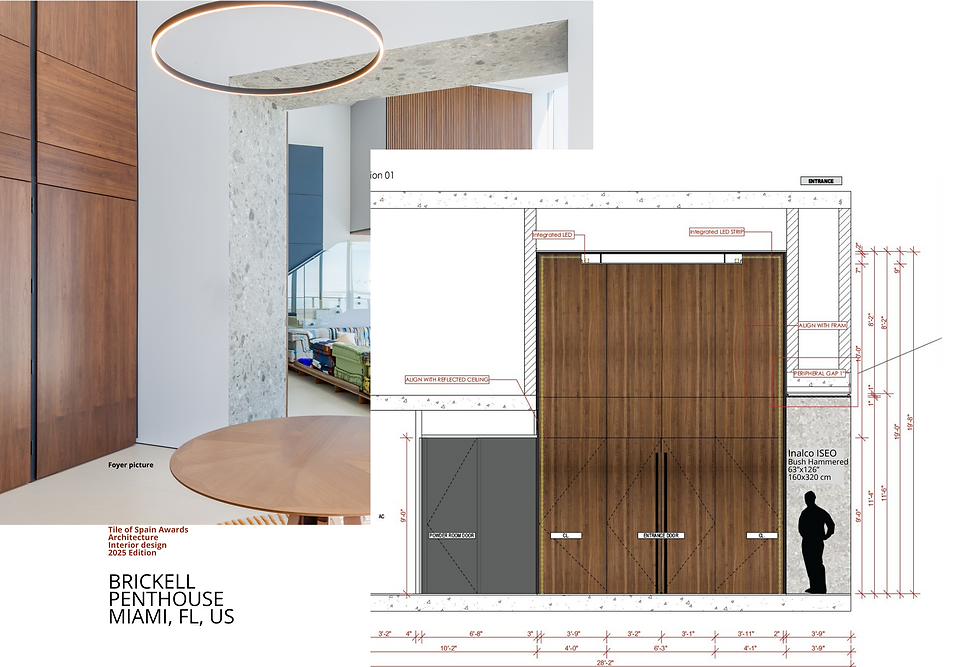
Once the spatial framework is established, the interior design develops in parallel with the project documentation. Materials, finishes, lighting, built-in furniture, bathroom and kitchen design, flooring, wall treatments, ceiling details. Every element is selected, developed, and documented for coordination with the project team.
The interior is not a layer applied after the fact. It is conceived from the outset as part of the same idea. A walnut ceiling that compresses a room to make the view beyond feel larger is not decoration. It is spatial design.
Material sourcing, supplier coordination, and sample validation are managed directly by the studio.
FF&E, Sourcing & Procurement
Loose furniture, lighting, textiles, rugs, and decorative objects are selected and procured as part of the design process. Each piece is chosen for its proportion, its material quality, and its relationship to the space it occupies.
Budget alignment, supplier negotiation, logistics, and installation scheduling are fully managed. The goal is a residence that is complete and move-in ready on the day of delivery, with nothing left to source, nothing left to decide.
Construction-Phase Design Coordination
During construction, TOGU Design provides aesthetic coordination to help preserve the design intent through key decisions related to materials, finishes, built-in elements, visual alignment, and overall spatial quality.
This role is distinct from contractor services, permitting, engineering, and sealed technical documentation, which are handled by the appropriate licensed professionals and project consultants where required.
The studio does not manage construction. It protects the design.